Maintenance · 3 min read
Asphalt Overlay vs. Full Replacement: Costs & How to Decide
Blackland Asphalt Team · February 20, 2026
This is the single most consequential pavement decision most property managers make, and it is usually made off a photo and a gut feeling.
The right answer depends almost entirely on what is under the asphalt, which is why the question cannot be answered honestly without looking.
What each option actually involves
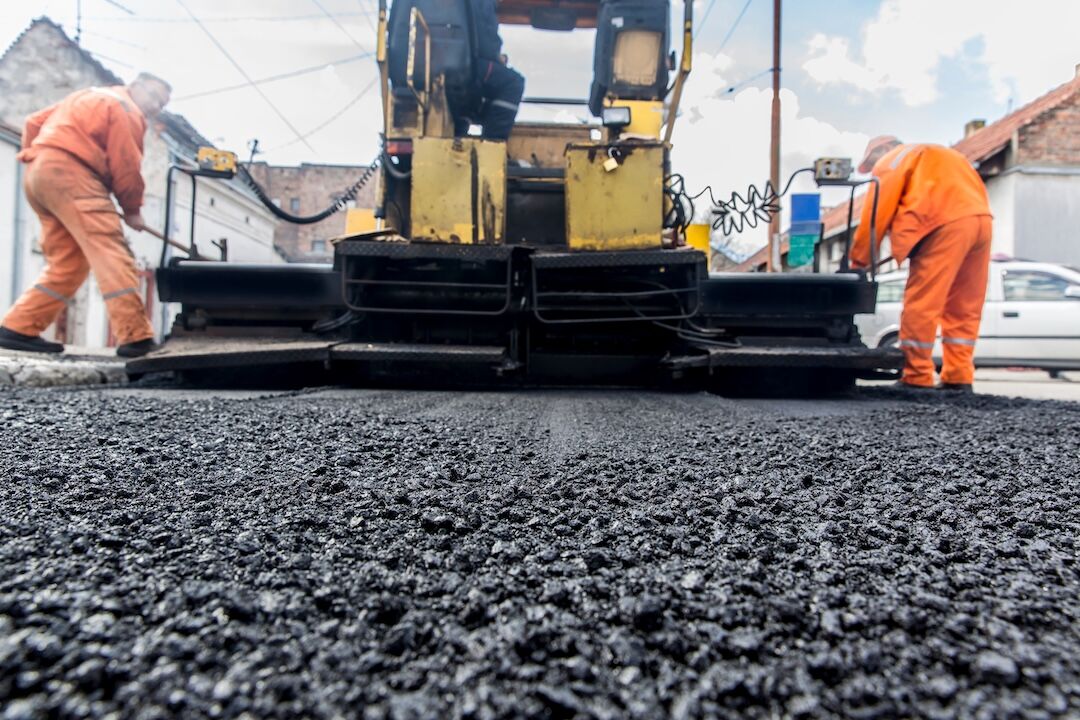
A mill and overlay removes the top inch or two of existing asphalt, mostly at transitions and edges, then places a new compacted mat over the remaining structure. The existing base and subgrade stay in place. It is faster, cheaper and far less disruptive.
A full-depth reconstruction removes the asphalt and typically the base, addresses the subgrade, rebuilds in compacted lifts and repaves. It costs roughly two to three times as much, takes longer, and resets the clock entirely.
Asphalt Overlay Cost
A two-inch mill and overlay in Dallas-Fort Worth generally runs $2.75 to $4.50 per square foot in 2026, against $6.50 to $12.00 per square foot for full-depth reconstruction. On a 40,000 square foot lot that is roughly $110,000 to $180,000 versus $260,000 to $480,000.
The overlay only holds that number when the problems are in the surface and the structure below is still doing its job. Every condition on this list has to be true:
- Distress is mostly oxidation, raveling, and non-fatigue cracking.
- Alligator cracking covers less than roughly 20 to 25 percent of the area and can be patched first.
- No rutting, pumping or visible pavement movement under traffic.
- Drainage is functional, or can be corrected as part of the work.
- Grades allow the added thickness without burying curbs or blocking door thresholds.
When an Overlay Won't Work
Certain signs mean the base has failed, and no amount of asphalt on top will fix a base problem. Placing two inches of new mat over a moving, saturated subgrade produces reflective cracking in the first year or two, and the owner ends up paying twice.
- Widespread alligator cracking across drive lanes and loading areas.
- Pumping: water or fines squeezing up through cracks under wheel loads.
- Rutting and shoving, especially where trucks turn or stop.
- Repeat potholes in the same locations after multiple patches.
- Cores showing a wet, unstable base or insufficient section for the loads.
The option most people miss
Very few lots are uniformly good or uniformly failed. The usual right answer is a hybrid: full-depth reconstruction of the drive lanes and truck routes where the loads are, plus patching and an overlay across the parking bays where cars sit.
This routinely lands 30 to 40 percent below full reconstruction while delivering nearly the same service life, because the money goes exactly where the loads are.
Getting there requires actually mapping the lot rather than pricing it as one number per square foot. That mapping is the assessment.
Compare cost per year, not cost
An overlay that costs half as much but lasts a third as long is not a bargain. Divide each option's cost by the service life you can reasonably expect, and compare the annual figures.
On Blackland clay, that math is sensitive to maintenance. An overlay maintained with crack sealing and sealcoating can outperform a neglected reconstruction, which is why we do not sell either one without a maintenance plan attached.