Commercial · 6 min read
HOA Road Maintenance Planning for North Texas Communities
Blackland Asphalt Team · October 29, 2026
When a developer hands over the keys to a gated community or private subdivision, HOA board members quickly discover that owning private streets is an expensive responsibility. In North Texas, effective hoa road maintenance planning determines whether a neighborhood stays financially solvent or gets hit with five-figure special assessments. National reserve study templates assume pavement sits on stable gravel or sand. In the Dallas-Fort Worth metroplex, your pavement sits on active, moisture-sensitive soil that demands a localized strategy.
Without an accurate pavement life-cycle plan, boards make one of two costly mistakes. They either defer maintenance until minor wear turns into full-depth subgrade failure, or they waste capital on cosmetic surface treatments applied over structurally broken roads.
Aligning HOA Road Maintenance Planning with Your Reserve Study
Most reserve studies are produced by financial analysts using national cost indexes and standardized life expectancies. A standard reserve study typically predicts that private asphalt streets will need crack sealing every few years, a sealcoat every four to six years, and a complete asphalt overlay at year twenty.
In North Texas, those timelines rarely hold up without aggressive intervention. Blackland Prairie clay features high plasticity index ratings, often exceeding 40 to 50. During prolonged summer droughts, this clay shrinks and pulls away from concrete curbs, creating massive longitudinal fissures. During wet winter months, the clay expands and pushes pavement upward.
If your reserve study assumes a standard 20-year cycle without accounting for localized subgrade movement, your reserves will fall short. Effective hoa road maintenance planning requires bringing an experienced paving contractor into the review process every three years to benchmark your actual pavement condition against the reserve fund schedule.
A realistic financial plan breaks pavement funding into three distinct buckets:
- Annual preventative maintenance: crack routing, hot-pour crack filling, and localized base patching.
- Intermediate preservation: surface sealants and micro-surfacings at years five through eight.
- Major capital restoration: profile milling, full-depth reclamation, or structural overlays between years fifteen and twenty.
Failing to fund bucket one guarantees that bucket three will arrive five to seven years early, at double the budgeted cost.
Private Street Standards and Subgrade Realities in North Texas
Municipal thoroughfares built for cities like Dallas or Fort Worth follow strict engineering manuals requiring six to eight inches of lime-stabilized subgrade beneath heavy base rock and deep surface courses. Private streets inside subdivisions rarely receive that level of scrutiny during initial construction.
To maximize lot yield and control upfront costs, developers frequently install minimal cross-sections on private streets. A common specification is six inches of crushed limestone flexible base topped with two inches of type D hot mix asphalt. When built on raw native soil without chemical stabilization, this pavement design has zero tolerance for water infiltration.
We see this issue constantly across fast-growing areas such as private subdivisions in Prosper, where expansive soils shift rapidly under seasonal rainfall variations. The moment water breaches the surface course, the base rock saturates. Under the weight of daily delivery vans and heavy multi-axle garbage trucks, that wet base liquefies, creating severe alligator cracking and deep rutting.
HOA boards must evaluate their streets based on structural capacity, not just surface color. If your roads deflect or bounce under the weight of an axle, applying a thin topical sealer is a bad buy. You cannot paint your way out of a subgrade failure. Structural repairs must precede surface treatments every single time.
The Maintenance Lifecycle: What Works and What Is a Bad Buy
A disciplined pavement maintenance program protects community assets by extending the functional life of the asphalt mat at the lowest possible cost per square yard.
Crack Sealing Is Mandatory
Water is the primary enemy of asphalt pavement in North Texas. Once a surface crack widens beyond a quarter of an inch, surface runoff flows straight into the flexible base and the clay subgrade below. Utilizing commercial-grade hot-pour crack sealing blocks that water entry. At roughly fifty cents to a dollar per linear foot, crack sealing delivers the highest return on investment of any maintenance procedure available to an association. It should be performed every twelve to eighteen months, ideally in late autumn after summer shrinkage cracks have fully opened.
Understanding Sealcoating
Sealcoating provides value on low-traffic residential streets, but only when applied at the correct stage of the pavement lifecycle. A high-solids asphalt emulsion sealer blocks UV oxidation, keeps oils inside the pavement, and resists fluid drips. However, it provides zero structural strength. Applying sealcoat over deep base failures, unsealed cracks, or completely oxidized, raveling asphalt is a waste of association reserves. Treat sealcoat as a preventative sunscreen for sound asphalt, not a structural repair.
Mill and Overlay Timing
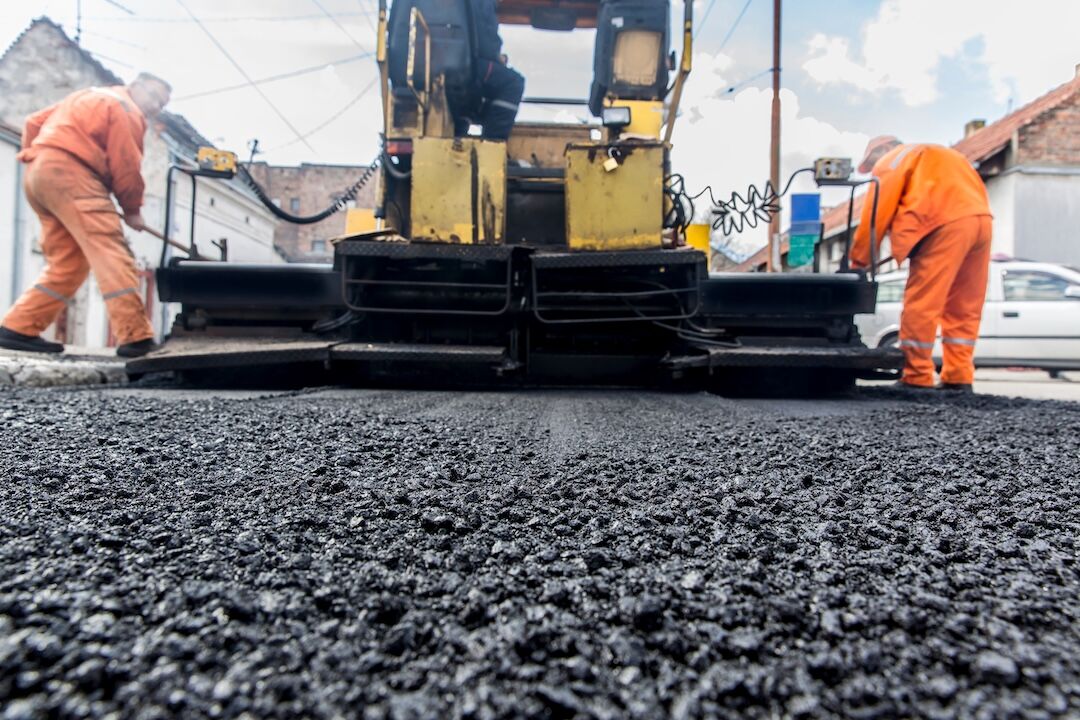
When pavement reaches fifteen to twenty years of age, minor patching is no longer cost-effective. At this stage, associations should look at structural asphalt overlays. A quality overlay project involves edge milling along concrete valley gutters and curb lines to preserve stormwater drainage profiles, performing full-depth saw-cut repairs on localized failures, and laying a new two-inch compacted surface course. Done correctly, an overlay resets the clock on your private road network for another fifteen years.
Phasing and Traffic Logistics Around Resident Access
Paving work inside an occupied community requires strict operational coordination. Unlike commercial parking lots that can be divided into large quadrants over a weekend, residential streets must accommodate school buses, mail carriers, emergency response vehicles, and residents who need to leave for work.
A contractor who treats your subdivision like an empty highway will create chaos for the board. Proper project planning requires strict logistical parameters:
- Phase Sequencing: Roads should be addressed in alternating phases so that adjacent streets remain open for resident parking. In cul-de-sacs and dead-end streets, work must be completed half-at-a-time or staged during narrow mid-day windows.
- Service Coordination: Project timelines must be coordinated with municipal sanitation, recycling, and mail routes. Rescheduling or staging around collection days prevents heavy garbage trucks from tracking uncured tack coat or crushing fresh asphalt.
- Clear Resident Communication: Homeowners need written notification at least two weeks in advance, followed by a reminder forty-eight hours prior to work on their specific block. Notification letters must provide exact vehicle relocation instructions and state clearly when towing will be enforced.
- Emergency Vehicle Contingencies: Local fire and police departments must receive phase maps showing detour routes and active work zones forty-eight hours before heavy equipment mobilizes.
When a board plans proactively, coordinates traffic, and treats the subgrade beneath the road with the respect North Texas soil requires, private street ownership shifts from an unpredictable emergency to a manageable capital asset.
Frequently Asked Questions
How often should our HOA update its road reserve study?
An association should update its financial reserve study every three years, but the board should walk the streets with a qualified paving contractor annually. In the DFW area, active soils can accelerate pavement failure rapidly, making purely mathematical five-year reserve updates dangerously outdated.
Why does asphalt crack along the curb lines in North Texas communities?
These longitudinal cracks happen when high-plasticity clay dries out and shrinks away from rigid concrete curbs during hot summer months. The unsupported edge of the asphalt then shears off under vehicle loads, creating long cracks that must be routed and sealed before fall rain arrives.
Can our HOA pave over existing concrete valley gutters to cut costs?
Paving over concrete drainage pans or valley gutters is almost always a mistake that damages community drainage. Asphalt does not bond well to flat, dirty concrete pans, and raising the road elevation over the gutter leads to edge-raveling and standing water along resident driveways.